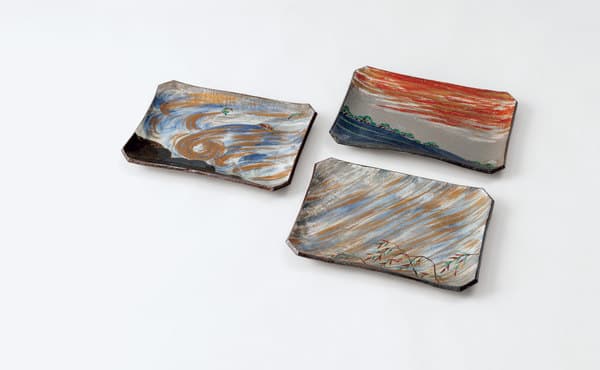
Kawamura Seizan
1890–1967
Rectangular Plates: Rain, Wind, Sky
Year unknown
Ceramic (set of 3)
Rain: 29.0×41.0×4.3cm Wind: 28.7×40.9× 4.2cm Sky: 28.4×41.7×3.9cm
Kawamura Seizan, the eldest son of an Awata-yaki (Awata ware) potter in Kyoto, won a gold medal at the 1925 International Exposition of Modern Industrial and Decorative Arts (popularly known as the Art Deco Exposition) in Paris. In 1938, at the age of 48, he relocated to Sanjuso in Tenjin’yama, Abiko City, Chiba, where he built a climbing kiln and associated with the Shirakaba school for a period of 16 years.
In Abiko, there was a period when Seizan extracted local reddish-brown clay from road cuttings and so forth, which he overlaid with white slip, applied ash glaze, and added decorative painting. This set of plates is viewed as belonging to this category. The decorative painting employs the kinrande (gold brocade) technique, with overglaze painting in vivid shades of blue, red, and green, along with gold paste, producing a brocade-like effect. Kinrande was first applied to Jingdezhen porcelain in late Ming dynasty (1368–1644) China, its name derived from its similarity to rich gold brocade on woven textiles, and gained popularity in Arita, Japan, in the late 17th century. Kawamura imbued the typically vibrant kinrande technique with a subdued and refined elegance. (A.J.)