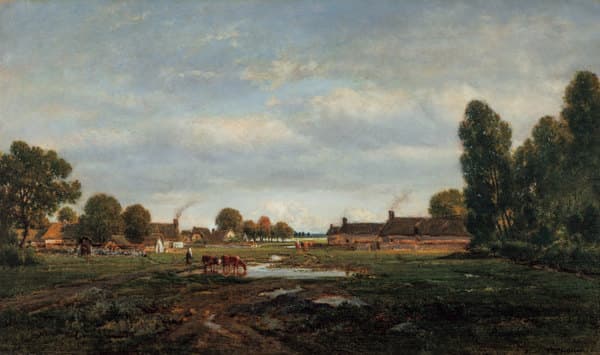
Théodore Rousseau
1812–1867
Farm in Barbizon
Circa 1850–55
Oil on canvas
33.4×55.5cm
Rousseau was a leading figure among the Barbizon school painters, a passionate lover of nature deeply attuned to the rustling of trees. After a string of rejections from the Salon that earned him the nickname “le grand refusé, ” Rousseau’s fortunes turned in 1855 when he was given an entire special gallery at the Universal Exposition, and he soared to high acclaim, serving as chairman of the jury at the same event in 1867.
This painting shows a picturesque scene in the village of Barbizon, where he had lived. In the tranquil rural setting, there is a cluster of stone-walled buildings, and cattle drink water and graze on grass. Rousseau excelled at a technique known as repoussoir, using darker tones in the foreground to enhance the brightly lit middle ground, compellingly conveying the expansive, flat landscapes characteristic of Barbizon farmland. (M.N.)